
Introduction
Imagine having a beautifully designed website, offering excellent products or services, and publishing useful content, but receiving almost no visitors from Google. You know your business has something valuable to offer, yet potential customers are finding your competitors instead. Why does this happen?
In many cases, the problem isn’t the quality of your business. It’s the lack of search visibility.
This is where Search Engine Optimization (SEO) becomes important. SEO helps your website appear in relevant search results when people look for information, products, or services related to your business. Instead of relying entirely on paid advertisements, you can attract visitors organically by making your website easier for search engines to discover, understand, and recommend.
But what exactly is SEO? How does it work, and how can you apply it to your own website?
In this guide, we’ll explain everything you need to know about SEO, from its basic definition to the practical steps involved in optimizing a website for better search visibility.
1. What Is SEO? Define SEO and Understand Its Meaning
SEO (Search Engine Optimization) is the process of improving a website’s visibility in organic search engine results by optimizing its content, technical structure, user experience, and authority. The primary goal is to attract relevant visitors from search engines such as Google without paying for every click.
If you’re searching for a simple way to define SEO, think of it as making your website more understandable, accessible, and useful for both search engines and people.
What Does SEO Actually Include?
SEO is not a single activity. It involves several interconnected practices that help improve a website’s overall search performance.
The main components include:
- Keyword Research: Identifying the search terms your potential customers use.
- On-Page SEO: Optimizing page titles, headings, content, images, and internal links.
- Technical SEO: Improving website speed, crawlability, indexing, mobile usability, and technical performance.
- Off-Page SEO: Building website authority through relevant backlinks and other external signals.
- Content Optimization: Creating helpful, relevant, and informative content that satisfies search intent.
SEO Definition: What Does SEO Stand For?
SEO stands for Search Engine Optimization. It is commonly abbreviated as SEO and refers to the methods used to improve a website’s position and visibility in unpaid search results.
You may also encounter the keyword variations “SEO def” and “SEO define” when people search for a quick explanation of the term.
Interestingly, the meaning of SEO is expressed differently across languages. For example, the Spanish term is optimización para motores de búsqueda, while the Romanian phrase ce inseamna SEO translates to “what does SEO mean?”
Regardless of the language, the fundamental purpose remains the same: helping people find relevant information through search engines.
2. How Does SEO Work?
SEO works by helping search engines discover your website, understand its content, store relevant pages in their index, and determine where those pages should appear in search results.
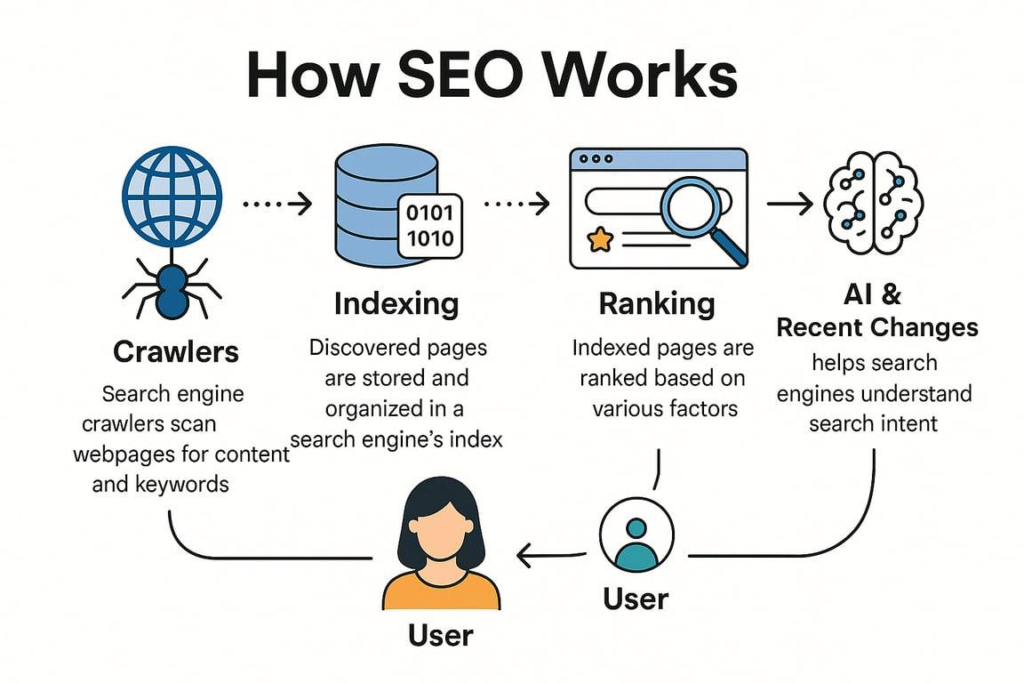
Google uses automated systems and algorithms to evaluate numerous factors when deciding which pages are most relevant and useful for a particular search query.
To understand how SEO works, you first need to understand three essential processes: crawling, indexing, and ranking.
1. Crawling: Discovering Your Website
Crawling is the process through which search engines use automated programs, commonly called crawlers or bots, to discover web pages.
Google’s primary web crawler is Googlebot.
It discovers pages through different sources, including:
- Links from other websites.
- Internal links between your website pages.
- XML sitemaps.
- Previously discovered URLs.
For example, when you publish a new blog post and link to it from your homepage, Googlebot may follow that link to discover the new page.
However, technical problems such as broken links, incorrect robots.txt rules, or server errors can prevent search engines from crawling certain pages.
2. Indexing: Understanding and Storing Your Content
After discovering a page, Google may process its content and determine whether it should be included in its search index.
Indexing involves understanding the page’s content, images, videos, and other relevant information.
For example, if you publish an article about technical SEO, Google attempts to understand whether the page provides useful information about website performance, crawling, indexing, and technical optimization.
Not every crawled page gets indexed. Duplicate content, low-value pages, technical restrictions, and other quality issues can affect indexing decisions.
You can use Google Search Console’s URL Inspection tool to check whether a particular URL is indexed.
3. Ranking: Showing Relevant Results
Ranking is the process of determining which indexed pages are most relevant to a user’s search query.
When someone searches for “SEO services for small businesses,” Google evaluates available pages and selects results based on relevance, content quality, usability, context, and other ranking systems.
Some important considerations include:
- Relevance to the search query.
- Helpful and reliable content.
- Website and page experience.
- Relevant links and authority signals.
- Mobile usability and accessibility.
- Search intent satisfaction.
Important: Getting indexed does not guarantee that your website will rank highly. Your content must also provide value and satisfy what users are actually searching for.
3. How Do SEO for a Website: A Step-by-Step Blueprint
If you’re wondering how do SEO for a website, the best approach is to follow a structured optimization process instead of making random changes.
Here is a practical blueprint explaining how SEO works step by step.
Step 1: Keyword Research
Keyword research is the foundation of an effective SEO strategy.
It involves identifying the words and phrases people enter into search engines when looking for products, services, or information.
For example, if you operate an SEO agency, potential target keywords might include:
- SEO Services
- Organic SEO Services
- Technical SEO Expert
- On-Page SEO Services
- Local SEO Services
- SEO Link Building Services
However, choosing keywords simply because they have high search volume is not enough.
You should also evaluate:
- Search Intent: What does the searcher actually want?
- Keyword Difficulty: How competitive is the keyword?
- Search Volume: How frequently is the keyword searched?
- Business Relevance: Can the keyword attract potential customers?
Tools such as Google Keyword Planner, Semrush, Ahrefs, and Google Search Console can help you identify relevant opportunities.
The objective is to target keywords that connect your website’s content with the needs of your audience.
Step 2: On-Page SEO Optimization
Once you’ve identified your target keywords, the next step is optimizing individual website pages.
On-page SEO helps search engines understand what each page is about while making the content easier for visitors to read and navigate.
Important on-page optimization activities include:
- SEO Title: Write a unique, descriptive title that communicates the page’s topic.
- Meta Description: Create a compelling summary that encourages relevant searchers to click.
- Heading Structure: Organize content using appropriate H1, H2, and H3 headings.
- Keyword Placement: Naturally include primary and related keywords in relevant sections.
- URL Structure: Use short, descriptive, readable URLs.
- Image Optimization: Compress images and add meaningful alternative text.
- Internal Linking: Connect related pages to improve navigation and help search engines discover content.
For example, a page targeting “Technical SEO Services” should clearly explain the technical problems you solve, the services you provide, and how those improvements benefit website owners.
Avoid repeating the same keyword unnecessarily. Helpful content should always come before keyword density.
Step 3: Technical SEO Setup
Technical SEO focuses on improving the infrastructure of your website so search engines can access, crawl, and understand its pages efficiently.
Even excellent content may struggle to perform if important technical problems prevent search engines from accessing it properly.
Here are some essential technical SEO tasks:
- XML Sitemap: Create and submit an XML sitemap to help search engines discover important URLs.
- Robots.txt: Configure crawling instructions correctly without accidentally blocking important pages.
- SSL Certificate: Ensure your website uses HTTPS for a secure connection.
- Canonical Tags: Identify preferred URLs when duplicate or similar pages exist.
- Broken Links: Find and fix internal and external links that lead to unavailable pages.
- Mobile-Friendliness: Make sure your website works properly on smartphones and tablets.
- Core Web Vitals: Monitor loading performance, responsiveness, and visual stability.
- Indexing Management: Ensure important pages can be indexed while unnecessary pages are handled appropriately.
Google Search Console is particularly useful for monitoring indexing issues, sitemap submissions, and website search performance.
You can also use tools such as Screaming Frog SEO Spider and Semrush Site Audit to identify technical problems that need attention.
Remember, technical SEO is not just about fixing errors. It’s about creating a website that search engines and visitors can access and use without unnecessary difficulties.
Step 4: Off-Page SEO and Link Building
Off-page SEO refers to activities performed outside your website to improve its authority, reputation, and visibility.
One of its most important components is link building.
A backlink is a link from another website pointing to your website. Relevant, trustworthy backlinks can help search engines understand how your content is connected to other resources across the web.
Effective link-building approaches include:
- Publishing original research and useful resources.
- Writing relevant guest contributions.
- Building relationships with industry websites.
- Creating link-worthy guides and educational content.
- Earning editorial backlinks through valuable information.
Quality matters much more than quantity.
For example, earning a relevant backlink from a respected industry website is generally more valuable than obtaining hundreds of unrelated links from low-quality websites.
Avoid manipulative link schemes, paid link arrangements intended to manipulate rankings, and automated backlink-building practices that violate Google’s spam policies.
A sustainable off-page SEO strategy focuses on earning trust rather than simply collecting links.
4. Why Modern SEO Matters for Business Growth
SEO is more than a method for increasing website traffic. When implemented strategically, it can become an important part of your long-term digital marketing and customer acquisition strategy.
Here are some reasons why businesses invest in SEO.
1. Attract Relevant Organic Traffic
SEO helps your website reach people who are already searching for information, products, or services related to your business.
This makes organic search an important channel for attracting visitors with genuine interest.
2. Build Brand Credibility and Trust
Websites that consistently provide useful information and appear for relevant searches can become more familiar to potential customers.
High search visibility does not automatically guarantee trust, but a helpful website with accurate information and a professional user experience can strengthen your brand’s credibility.
3. Generate Long-Term Business Opportunities
Unlike paid advertising, where visibility generally stops when your budget runs out, well-optimized content can continue attracting organic visitors over time.
However, rankings are never permanent. Regular content updates, technical maintenance, and ongoing optimization are important for maintaining performance.
4. Understand Your Customers Better
SEO research provides valuable insights into what your audience searches for, what questions they ask, and which problems they want to solve.
You can use these insights to create better content, improve your services, and develop more relevant marketing strategies.
5. Prepare Your Website for Modern Search Experiences
Search behavior continues to evolve. People increasingly interact with AI-powered search experiences and conversational answer engines.
This makes Answer Engine Optimization (AEO) an important consideration alongside traditional SEO.
AEO focuses on structuring useful, accurate, clearly written information so answer engines can better understand and potentially reference it when responding to relevant questions.
Useful approaches include:
- Answering common questions directly.
- Using descriptive headings.
- Providing clear definitions.
- Organizing information with lists and structured content.
- Demonstrating expertise and providing trustworthy information.
- Implementing relevant structured data where appropriate.
SEO and AEO work toward a shared objective: making useful information easier to discover and understand.
Conclusion: Start Improving Your Website’s Search Visibility with SASNations
Understanding what SEO is and how it works is the first step toward building a stronger online presence.
From keyword research and on-page optimization to technical improvements and link building, every part of SEO contributes to making your website more accessible, relevant, and useful.
However, successful SEO requires more than completing a checklist once. It involves continuous analysis, strategic planning, performance monitoring, and improvements based on real data.
At SASNations, we help businesses strengthen their online presence through practical, data-driven SEO strategies. Our services cover keyword research, technical SEO audits, on-page optimization, off-page SEO, link building, and performance analysis using tools such as Google Search Console and Google Analytics.
Whether you’re launching a new website or looking to improve an existing one, the right SEO strategy can help you reach your target audience and create more opportunities for business growth.
Ready to improve your website’s search visibility?
Explore SASNations SEO Services and discover how a well-planned SEO strategy can support your business goals.