
publishing a website does not guarantee that potential customers will find it.
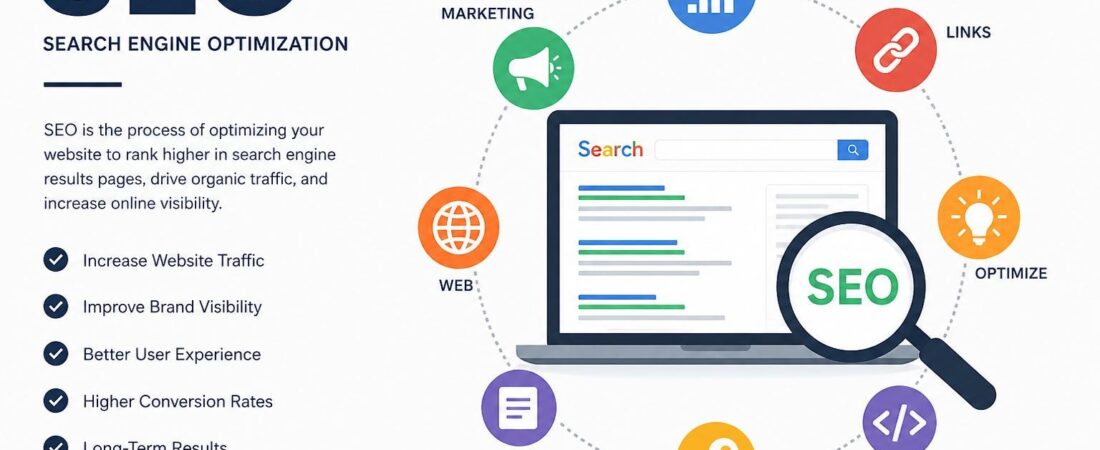
SEO, or Search Engine Optimization, is the process of improving a website and its content so search engines can better discover, understand, and present its pages to people searching for relevant information, products, or services.
SEO involves several connected activities, including Keyword Research, On-Page SEO, Technical SEO, Off-Page SEO, Link Building, and Local SEO. Together, these activities help create a website that is useful to visitors and easier for search engines to understand.
In this guide, you will learn what SEO is, how it works, why it matters for businesses, the main types of SEO, how long SEO can take, and how traditional SEO connects with newer approaches such as AEO and GEO.
What Is SEO?
SEO is the practice of improving a website’s content, structure, technical accessibility, and online reputation to increase its visibility in relevant organic search results.
Unlike paid advertising, organic search visibility is not purchased simply by paying for an advertisement. Instead, SEO focuses on making a website useful, accessible, understandable, and relevant to the searches it aims to serve.For example, imagine a local business sells professional accounting services.
A potential customer searches:
“accounting services for small businesses”
An SEO strategy might help that business by:
- Researching what potential customers search for
- Creating a useful service page around the topic
- Writing clear and relevant content
- Improving page titles and headings
- Making the website technically accessible
- Building relevant internal links
- Earning relevant external mentions and links
- Improving local search visibility where appropriate
SEO is therefore not one single task. It is a collection of related practices that work together.
How Does SEO Work?
SEO works by helping search engines discover webpages, access and understand their content, evaluate their relevance and quality, and determine where those pages may appear for relevant searches.
At a simplified level, the process looks like this:
Website → Crawling → Understanding → Indexing → Search Results
1. Crawling
Search engines use automated systems to discover webpages and follow links to other pages.
A technically accessible website makes it easier for search engines to discover important content.
2. Understanding Content
Search engines analyze the content and structure of a page to understand what it is about.
Clear headings, descriptive page titles, relevant text, internal links, structured data where appropriate, and logical website architecture can all help communicate meaning.
3. Indexing
If a page is eligible to be indexed, a search engine can store information about that page in its index.
Indexing does not mean a page will automatically rank highly for its target queries.
4. Ranking and Search Results
When someone performs a search, search engines determine which available results are most appropriate for that query.
Many factors can influence how results are displayed. The exact systems used by search engines are complex and continuously developed, so SEO should focus on creating genuinely useful content and a technically sound website rather than attempting to manipulate individual ranking signals.
Why Is SEO Important for Businesses?
SEO can help businesses attract relevant organic search traffic from people who are actively looking for information, products, or services related to the business.
Some potential benefits include:
Greater Organic Visibility
A well-optimized website can become discoverable for a broader range of relevant searches.
More Relevant Traffic
SEO is most useful when it targets the topics and questions that matter to the intended audience. Reaching people with relevant search intent can be more valuable than simply increasing visitor numbers.
Better User Experience
Good SEO often overlaps with good website practices. Clear navigation, useful content, readable pages, mobile usability, and fast-loading experiences can benefit visitors as well as search engines.
Long-Term Marketing Asset
Unlike an advertising campaign that generally stops generating paid exposure when the budget stops, useful organic content can continue attracting visitors over time. However, SEO still requires monitoring, maintenance, and improvement.
Stronger Online Presence
Consistent, helpful content can help a business establish topical relevance and demonstrate expertise within its market.
What Are the Main Types of SEO?
SEO is often divided into several categories. These categories overlap, but each addresses a different part of the optimization process.
On-Page SEO
On-page SEO focuses on improving the content and elements that exist on individual webpages so they clearly satisfy the user’s search intent.
Important areas include:
- Search intent
- Page titles
- Headings
- Main content
- Keyword and topic relevance
- Meta descriptions
- Internal linking
- Image optimization
- Descriptive image alt text
- Content structure and readability
For example, if a page targets the topic “how to choose running shoes,” it should actually answer that question rather than simply repeating the phrase “running shoes” throughout the page.
Professional On Page SEO Services may involve optimizing existing pages, improving content structure, identifying missing topics, and strengthening internal links.
Technical SEO
Technical SEO focuses on making a website accessible, crawlable, indexable, and technically sound for both users and search engines.
Technical SEO can include
- Crawlability
- Indexability
- XML sitemaps
- Robots.txt configuration
- Mobile usability
- Site architecture
- Page performance
- HTTPS
- Canonicalization
- Redirects
- Broken links
- Structured data
- Duplicate or conflicting technical signals
For example, a website might contain excellent content, but if important pages cannot be crawled or indexed properly, that content may struggle to receive organic visibility. A Technical SEO Service can identify and resolve these types of problems. Businesses with complex websites may also work with a Technical SEO Expert for deeper technical analysis
Off-Page SEO
Off-page SEO refers to activities and signals that occur outside your own website and can contribute to its online reputation, authority, and discoverability.
One important area is earning relevant backlinks from other websites.
Other activities may include:
- Digital PR
- Relevant website mentions
- Relationship building
- Content promotion
- Brand visibility
- Ethical link acquisition
The goal should not be to collect as many links as possible. Relevance, quality, context, and natural acquisition matter more than simply increasing the number of backlinks.
An Off Page SEO Expert may analyze a website’s backlink profile, identify opportunities, and develop a sustainable off-page strategy.
SEO Link Building
SEO link building is the process of earning or acquiring relevant links from other websites to useful pages on your website. Effective link building should support real value rather than rely on manipulative link schemes. For example, publishing original research, useful resources, expert insights, or genuinely valuable guides can create reasons for other websites to reference your content.
Local SEO
Local SEO focuses on improving a business’s visibility when people search for relevant products or services in a specific geographic area.
For a local business, important areas may include:
- Google Business Profile
- Business information consistency
- Local relevance
- Customer reviews
- Location-specific website content
- Relevant local citations
- Local links and mentions
For example, someone searching for “SEO agency in Dhaka” has a different search intent from someone searching for “what is SEO?”
Local SEO Services can help businesses target location-based search opportunities more effectively.
What Is Keyword Research?
Keyword Research is the process of identifying and analyzing the words, phrases, questions, and topics people use when searching for information, products, or services.
Good keyword research is about more than finding high-volume phrases.
An SEO specialist should consider:
- Search intent
- Relevance to the business
- Topic relationships
- Competition
- Searcher’s needs
- Commercial or informational intent
- Geographic intent where relevant
For example:
| Search Query | Likely Intent |
| What is SEO? | Informational |
| How does SEO work? | Informational |
| SEO services | Commercial |
| SEO agency in Dhaka | Local/commercial |
| Hire SEO expert | Transactional/commercial |
This distinction helps determine what type of page should be created.
What Are SEO Services?
SEO Services are professional activities designed to improve a website’s organic search visibility, technical health, content relevance, and overall search performance.
Depending on the business and website, professional SEO Services may include:
- Website and SEO audits
- Keyword research
- Search intent analysis
- On-page optimization
Technical SEO
- Content strategy
- Internal linking
Local SEO
- Off-page SEO
- Link-building strategy
- Competitor analysis
- Performance monitoring and reporting
Organic SEO Services generally focus on improving unpaid search visibility through these types of activities rather than relying primarily on paid search advertising.An SEO specialist may focus on specific areas of SEO, while an SEO expert may have broader experience across technical, content, local, and off-page strategies.
The right approach depends on the website, industry, competition, resources, and business objectives.
How Do SEO Experts Analyze Competitors?
Competitor SEO analysis involves studying competing websites to understand their content, keyword targeting, website structure, backlinks, strengths, weaknesses, and opportunities.
One useful method is competitor backlink analysis.
This involves examining questions such as:
- Which websites link to competitors?
- What types of content attract those links?
- Are there relevant websites the business could build relationships with?
- Which topics have competitors covered well?
- Where are competitors missing useful information?
- Which pages appear to attract organic visibility?
The purpose is not to copy competitors.
Instead, competitor analysis can reveal market gaps and opportunities to create something more useful or comprehensive.
How Long Does SEO Take to Work?
SEO does not have a universal timeline, and no responsible SEO professional can guarantee a specific ranking date.
The time required can vary based on factors such as:
- Website history
- Technical condition
- Content quality
- Competition
- Search demand
- Industry
- Website authority
- Existing backlinks and mentions
- Resources available for implementation
- Frequency and quality of optimization
A new website in a competitive industry may require substantially more work than an established website with strong technical foundations and useful content.
Rather than asking only, “How quickly will I rank?”, businesses should monitor meaningful progress such as improved technical health, stronger content coverage, increasing impressions, relevant organic traffic, and qualified leads.
When Should You Hire an SEO Expert?
Hiring an SEO expert can make sense when SEO is important to your business but you lack the time, expertise, or internal resources to manage it effectively.
Professional help may be particularly useful when:
- Your website receives little organic traffic
- Important pages are not being indexed
- Your website has technical problems
- You are launching a new website
- You are entering a competitive market
- You need a structured content strategy
- You want to improve local visibility
- Your existing SEO efforts lack measurable direction
- You need help understanding competitors
- You have experienced a significant decline in organic performance
If you decide to hire an SEO expert, look for someone who explains the strategy clearly, avoids unrealistic guarantees, and focuses on sustainable improvements rather than shortcuts.
SEO, AEO and GEO: What’s the Difference?
Traditional SEO focuses primarily on helping content become discoverable and useful within search engines and organic search results.
AEO, or Answer Engine Optimization, focuses on making information clear and useful for systems that provide direct answers to user questions.
GEO, or Generative Engine Optimization, focuses more broadly on helping content be understandable, useful, and potentially discoverable within generative AI and conversational search experiences.
A simple way to understand the relationship is:
- SEO → establishes strong search fundamentals
- AEO → emphasizes clear answers and question-focused information
- GEO → emphasizes structured, context-rich information that generative systems can interpret
These approaches overlap considerably.
For example, a page answering “What is technical SEO?” can benefit from:
- A clear definition
- A direct answer near the beginning
- Descriptive headings
- Supporting examples
- Related concepts
- Structured explanations
- Accurate information
- Internal links to deeper resources
- Businesses offering AEO Services or GEO Services should therefore treat these approaches as complementary to strong SEO fundamentals, not as guaranteed shortcuts to visibility in AI-generated results.
Common SEO Mistakes to Avoid
SEO becomes less effective when businesses focus on shortcuts instead of users.
Common mistakes include:
1. Keyword Stuffing
Repeating the same keyword excessively can make content unnatural and reduce its usefulness.
2. Creating Content Only for Search Engines
Content should answer real questions and solve real problems rather than exist simply to target keywords.
3. Ignoring Technical Problems
Excellent content cannot compensate for every technical problem. Important pages need to be accessible and properly configured.
4. Buying Low-Quality Backlinks
Large quantities of irrelevant or manipulative links are not a substitute for earning relevant, trustworthy references.
5. Ignoring Search Intent
A page targeting an informational query should actually provide useful information rather than immediately trying to sell something.
6. Publishing and Never Updating
Some topics change over time. Reviewing important pages periodically helps keep information accurate and useful.
7. Expecting Instant Results
SEO is generally a long-term process. Sustainable progress requires testing, implementation, measurement, and refinement.
Frequently Asked Questions
What is SEO in simple words?
SEO is the process of improving a website so search engines can understand it and users can discover useful, relevant pages through organic search.
How does SEO work?
SEO works through activities such as keyword research, content optimization, technical improvements, internal linking, and off-page promotion. Search engines then crawl, understand, index, and evaluate webpages when determining which results to show for searches.
Is SEO free?
Organic search traffic does not require paying for each click like pay-per-click advertising. However, SEO itself requires resources, such as time, content creation, technical work, tools, or professional SEO services.
What is the difference between on-page and off-page SEO?
On-page SEO focuses on elements within your website, such as content, headings, titles, images, and internal links. Off-page SEO focuses on external signals and activities, including relevant backlinks, mentions, and digital relationships.
What is technical SEO?
Technical SEO focuses on the technical aspects that help search engines access, crawl, understand, and index a website. It can include site architecture, XML sitemaps, robots.txt, mobile usability, redirects, structured data, and other technical areas.
How long does SEO take?
There is no fixed timeline. Results depend on the website, competition, industry, content quality, technical condition, authority, and the amount and consistency of work performed.
Should a small business invest in SEO?
SEO can be valuable for small businesses when potential customers use search engines to discover their products or services. The best strategy depends on the business’s market, audience, competition, location, and available resources.
Conclusion
SEO is much more than adding keywords to webpages.
It is a connected process involving Keyword Research, On-Page SEO, Technical SEO, Off-Page SEO, Link Building, and Local SEO. Each component addresses a different part of the search visibility puzzle.A strong SEO strategy starts by understanding what people are looking for, creates genuinely useful content to satisfy that intent, ensures the website can be properly accessed and understood, and builds relevant authority over time.
Modern search is also evolving. A strong SEO foundation can support efforts related to AEO and GEO, where clear answers, context, structure, and useful information become increasingly important across search and generative experiences.
If you want to improve your website’s organic search presence, explore the SASNations SEO solutions and identify the areas where your website needs the most attention.
Ready to improve your website’s search visibility? Contact SASNations to discuss an SEO strategy based on your website, audience, and business goals.
WordPress Publishing SEO Details
SEO Title: What Is SEO and How Does It Work? Complete Beginner’s Guide
Meta Description: Learn what SEO is, how search engines work, and how on-page, technical, off-page, local SEO, keyword research, AEO and GEO can improve search visibility.
URL Slug: what-is-seo-and-how-does-it-work
Primary Keyword: SEO Services
Secondary Keywords: Organic SEO Services; On Page SEO Services; Off Page SEO Expert; SEO Link Building Services; Technical SEO Expert; Technical SEO Service; Keyword Research; Local SEO Services; SEO marketing; SEO specialist; SEO expert; competitor backlink analysis; AEO Services; GEO Services; hire SEO expert
Image Alt Text: SEO optimization illustration showing search engine visibility, keyword research, technical SEO, backlinks and organic website growth
WordPress placement: Use the supplied SEO image as the Featured Image. If desired, you can also place it near the beginning of the article after the introduction, but avoid duplicating the same image unnecessarily.Internal linking: Replace each placeholder with the actual SASNations page URL only when that page exists. Do not invent URLs.